Blog · Arrington Appliance Repair Pro
Dishwasher Not Cleaning? Start With the Filter Nobody Knows About
Most dishwashers accused of dying are actually suffocating: a filter loaded with months of food soil, spray-arm jets narrowed by mineral scale, and water too restricted to do its w...
Mon–Fri 7AM–7PM · Sat 8AM–4PM · 24/7 Emergency
The Short Answer
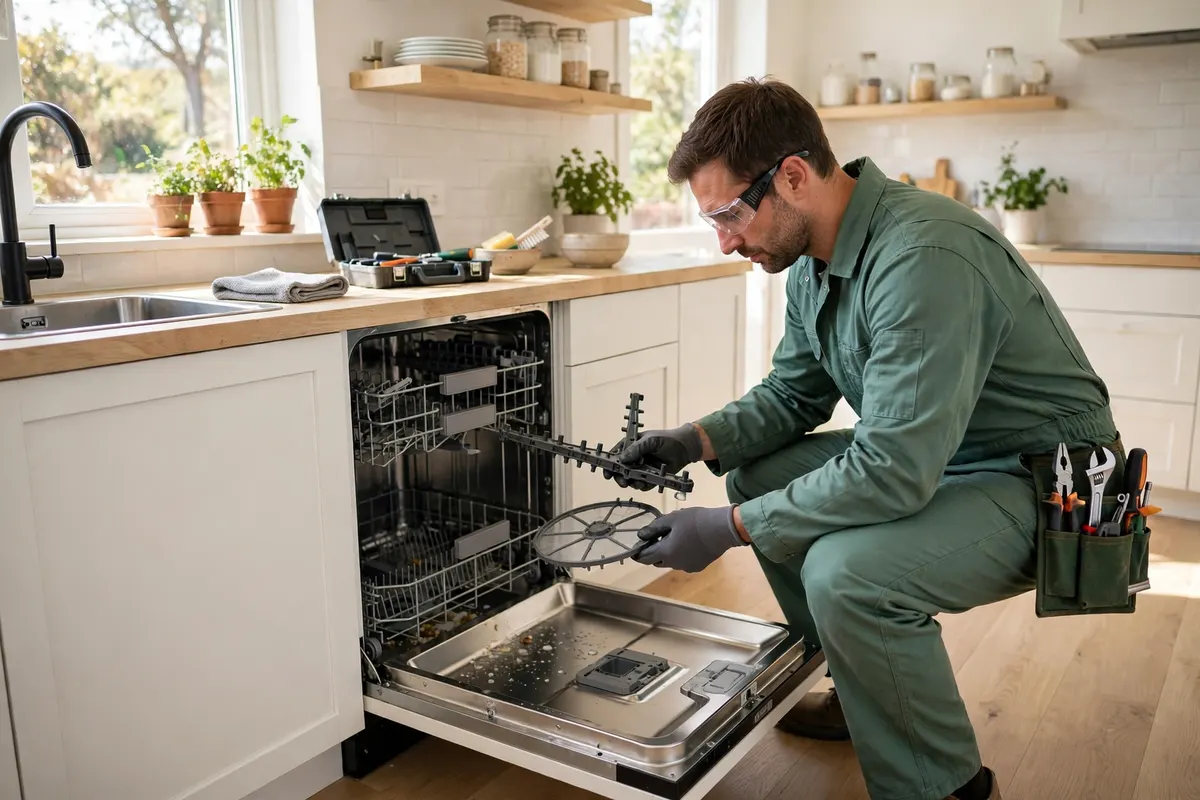
Most dishwashers accused of dying are actually suffocating: a filter loaded with months of food soil, spray-arm jets narrowed by mineral scale, and water too restricted to do its work. The machine is rarely the first problem. Here is the order we work through in Arrington kitchens, where well water stacks the deck.
Step one: the filter
Nearly every modern dishwasher has a removable filter in the tub floor, and a surprising share of owners have never met it. A clogged filter recirculates dirty water, redepositing grit on glasses and leaving the tub smelling like a swamp. Pull it, rinse it, and run a cycle before concluding anything about the machine. Monthly cleaning is the habit that prevents most dirty-dish calls.
Step two: spray arms and loading
Spray arms spin because water jets push them; when scale or debris plugs the jets, arms stall and whole zones of the rack go unwashed. Check that arms spin freely by hand and that no tall pan is blocking rotation. Loading matters too: bowls nested tight and a pan shielding the upper rack will defeat a healthy machine.
Step three: water, heat, and Arrington scale
Weak inlet valves and scaled screens reduce fill volume; a failed heating element leaves water too cool to activate detergent and dissolve grease. In 37014, hard well water drives both: scale narrows valve screens and coats elements. If your softener has quietly quit, the dishwasher is often the first appliance to report it, with cloudy glasses as the headline.
Our dishwasher repair visits test fill, pressure, and heat in sequence, and the well water guide explains the whole-house picture.
When it really is the machine
Wash pumps weaken, diverter motors stick so only one rack gets washed, and control boards mis-time cycles. Those present as consistent failure patterns after the filter, arms, and water checks pass. Pumps and diverters are mid-range repairs worth doing on most machines; boards on old entry-level units deserve the replacement comparison.
Keep Reading
Detergent, Pods, and the Hard-Water Interaction
Detergent pods assume average water. Arrington well water is not average: hardness consumes detergent chemistry before it reaches the soil on your dishes, which tempts people into double-podding, which then leaves residue of its own. Powder or gel with a dose you can adjust often outperforms fixed pods in hard water, and rinse aid stops being optional. If you soften your water, the equation flips again; very soft water plus full detergent doses can etch glass over time.
The practical sequence stands: filter, arms, water path, detergent match. Work it before you shop for a new dishwasher; we have un-sold many replacements with a twenty-minute descale and an honest conversation about soap.
The Two-Week Test
After working the steps in this article, give the machine two weeks of normal loads before judging it. Filters and descaling often restore performance gradually as residual scale clears from the water path.
Questions & Answers
Either the upper spray arm is clogged or blocked, or the diverter that sends water upward is failing. Arm first: it is free to check and frequently the whole story.
Mineral film from hard water can be treated and usually reverses; etching is permanent micro-damage from soft water plus harsh detergent. A vinegar rinse test on one glass tells you which you have.
Hot enough to matter: most machines boost water to roughly 120 to 140 degrees for washing and sanitation. A dead heating element quietly removes that boost, and drying suffers first.
In Arrington’s hard water, yes. Rinse aid is the difference between water sheeting off glasses and beading into spots. It is the cheapest performance upgrade a dishwasher has.